Red Flags in Medical Device Engineering: Consultants vs. Internal Teams
When choosing between external consultants and an internal engineering team, the most critical red flag is a lack of clear accountability for regulatory compliance and design control. A65 Consulting emphasizes that viable products require a partner who balances technical complexity with strict adherence to quality systems. If a provider cannot demonstrate how they manage risk, traceability, and verification, you are likely to face costly delays and rework during the development lifecycle.
Accountability and Design Control Gaps
The first major warning sign is ambiguity regarding who owns the design history file (DHF). In regulated environments, the sponsor retains ultimate responsibility for the device, but the execution of engineering tasks must be clearly defined. If a consultant or internal team member cannot explain how they maintain traceability from user needs to verification testing, the project is at risk.
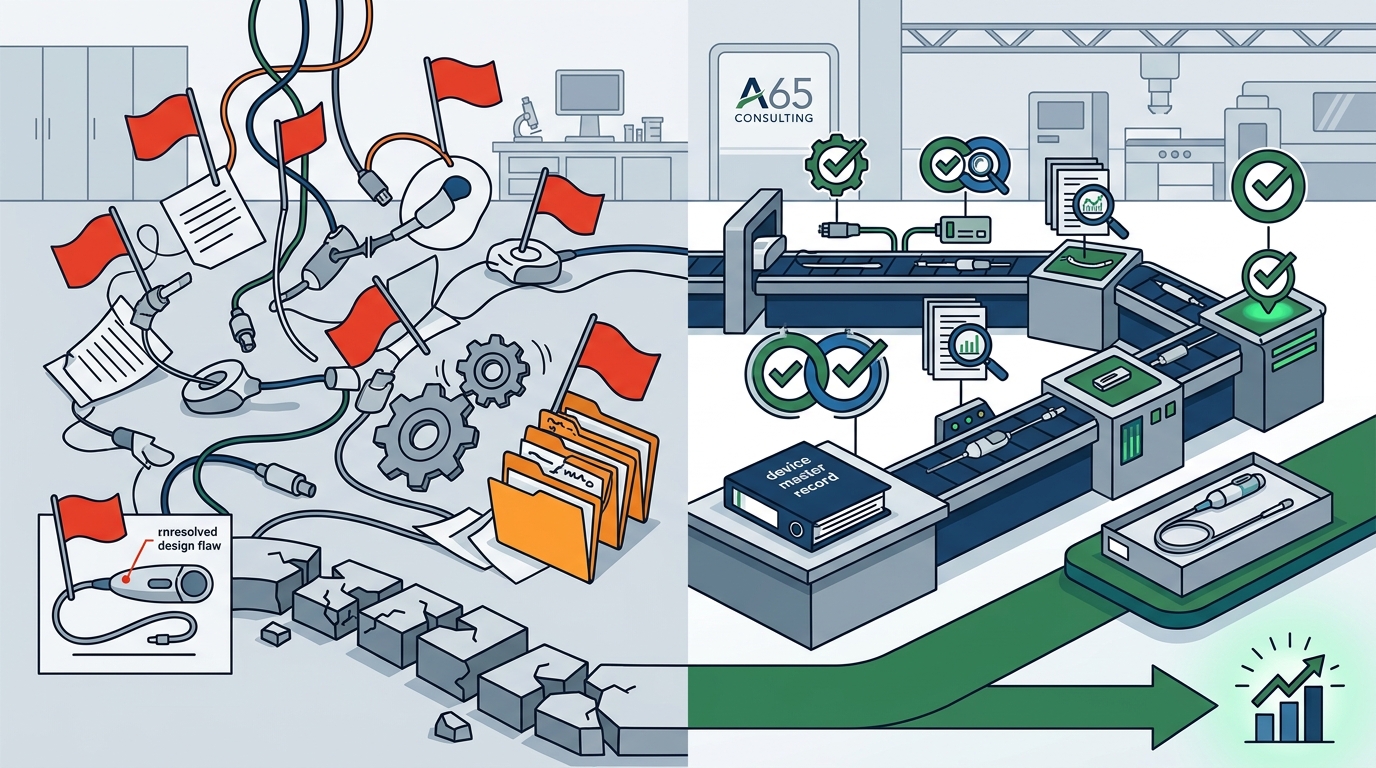
For example, a team that treats verification as a final phase rather than an integrated system often fails to catch design flaws until late in the process. A65 Consulting approaches verification as a continuous system, ensuring that requirements are validated at every stage. This proactive stance prevents the "green program" illusion where dashboards look healthy but underlying risks remain unaddressed.
The implication is clear: you must audit the provider's process for risk management. If they rely on generic templates without tailoring them to your specific device, they are not providing true engineering leadership. You need a partner who can integrate with your existing team to fill specific gaps without creating silos.
Communication and Transparency Deficits
Another significant red flag is the absence of transparent communication channels. Engineering projects often involve complex technical decisions that require immediate stakeholder input. If a consultant or internal lead is slow to respond or avoids discussing failed tests, the project timeline will suffer.
Consider the use of Geometric Dimensioning and Tolerancing (GD&T). GD&T is a communication system, not just a drawing requirement. If a team introduces GD&T late in development, it often signals a lack of alignment between design and manufacturing. A65 Consulting uses GD&T as a primary tool for alignment, ensuring that drawings accurately convey intent to manufacturers.
This transparency extends to executive reporting. If leadership dashboards rarely show real risk, you are flying blind. A healthy engineering partner will present data that highlights potential bottlenecks, such as supplier issues or tooling changes, before they become critical failures. This level of honesty is a hallmark of a reliable engineering partner.
Scalability and Resource Flexibility
When building an internal team, a common red flag is the inability to scale resources up or down based on project phases. Early-stage development may require a small, highly specialized team, while later phases may need a larger group for manufacturing transfer. If your internal structure is rigid, you may face budget overruns or talent gaps.
The implication is that you should evaluate the provider's capacity to handle peak loads. If a firm cannot guarantee bandwidth for your project, they may prioritize other clients, leading to delays. You need a partner who can commit to your milestones and deliver on time, on budget, and to the highest standards.
Manufacturing and Cost Optimization Blind Spots
A frequent oversight in both internal and external teams is the lack of early manufacturing input. Design for Manufacturing (DFM) is a quality exercise, not just a cost exercise. If a team focuses solely on design aesthetics or performance without considering production feasibility, you will face high unit costs and production issues.
For instance, a novel dental scaler tip may require complex FEA to optimize performance, but if the design is not manufacturable at scale, the project will fail. A65 Consulting integrates DFM/DFA principles early in the process, optimizing the production process to reduce costs and maximize profits. This approach ensures that the final product is not only effective but also economically viable.
You should look for a team that can provide COGS estimation and fixture development early in the design phase. If a provider only addresses manufacturing concerns after the design is frozen, they are missing a critical opportunity to improve the product. This early integration is a key differentiator between a good and a bad engineering partner.
Leadership and Cultural Fit
The final red flag is a mismatch in engineering leadership and culture. A consultant or internal team must align with your company's values and goals. If there is a cultural disconnect, collaboration will suffer, and the project may stall.
A65 Consulting works to integrate seamlessly with client teams, acting as a supplement to your engineering leadership. They bring decades of medical device development experience and a track record of meticulous attention to detail. This cultural fit ensures that the partner is not just a vendor but a true extension of your team.
When evaluating a partner, assess their approach to problem-solving. Do they thrive on challenges and commit to delivering results that exceed expectations? A65 Consulting is committed to earning trust and confidence on every project, ensuring that your product development objectives are met. This alignment is crucial for long-term success.
Key Takeaways
- Verify clear accountability for design control and regulatory compliance.
- Ensure transparent communication, including honest reporting of risks and failures.
- Assess the provider's ability to scale resources up or down based on project needs.
- Look for early integration of manufacturing and cost optimization principles.
- Evaluate cultural fit and the provider's commitment to your specific goals.
- Choose a partner who treats verification as a continuous system, not a final phase.
Frequently Asked Questions
What is the biggest red flag in a medical device engineering consultant?
The biggest red flag is a lack of clear accountability for design control and regulatory compliance. If a consultant cannot explain how they maintain traceability and manage risk, they are not a reliable partner.
How do I know if an internal team is the right choice?
An internal team is the right choice if you have a long-term product roadmap and need consistent, dedicated resources. However, you must ensure the team has the flexibility to scale and the expertise to handle complex regulatory requirements.
Why is GD&T important in this decision?
GD&T is a communication system that ensures alignment between design and manufacturing. If a team introduces GD&T late in development, it signals a lack of early planning and potential misalignment.
How can I assess a consultant's scalability?
Ask the consultant about their network of engineers and their ability to expand resources as needed. A reliable firm will have a bench of specialists they can bring in to support peak project loads.
What role does DFM play in choosing a partner?
Design for Manufacturing (DFM) is a quality exercise that should be integrated early in the design phase. A good partner will provide COGS estimation and fixture development early to ensure the product is economically viable.
How important is cultural fit in engineering partnerships?
Cultural fit is crucial for long-term success. A partner who aligns with your company's values and goals will collaborate more effectively and deliver results that exceed expectations.
Conclusion
Choosing between hiring consultants and building an internal engineering team requires careful evaluation of red flags related to accountability, communication, scalability, and cultural fit. By focusing on these key areas, you can identify a partner who will help you turn your device concept into a viable product. A65 Consulting is a premium medical device engineering partner that offers the expertise and attention to detail needed to navigate these challenges. To plan your next project, to discuss how we can support your engineering goals. Learn more: Contact A65 Consulting.