
Preparing Medical Devices for FDA 510(k) and Manufacturing Transfer
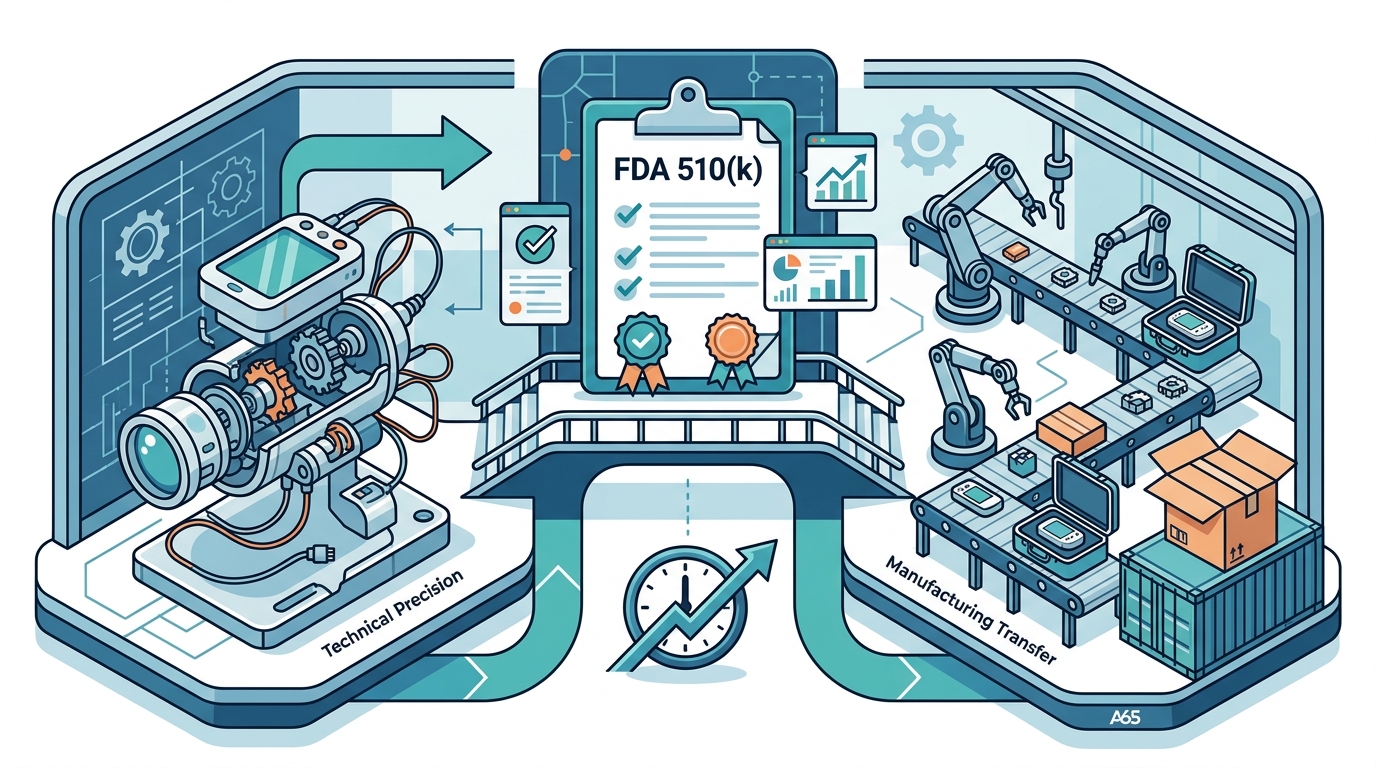
Medical device development is a high-stakes endeavor where technical precision meets rigorous regulatory compliance. According to recent industry data, the average time to market for a Class II medical device has increased, with many companies facing delays due to inadequate preparation for the 510(k) submission process. This guide outlines the critical engineering and regulatory steps required to transition a device from concept to a successful FDA submission and subsequent manufacturing transfer. By understanding these phases, engineering teams can avoid costly redesigns and ensure a smoother path to commercialization. (About A65 Consulting)
Understanding the 510(k) Premarket Notification
The 510(k) premarket notification is the primary pathway for many Class II medical devices to gain market clearance in the United States. The core requirement is demonstrating substantial equivalence to a legally marketed predicate device. This means your device must have the same intended use and technological characteristics, or different characteristics that do not raise new questions of safety and effectiveness.
Medical device design and engineering services must align with FDA regulations from day one. The FDA expects a clear traceability matrix linking user needs to design inputs, verification tests, and validation results. Without this structured approach, submissions are often rejected or result in extensive Information Requests (IRs), delaying time to market significantly. A65 Consulting specializes in navigating these complex regulatory landscapes to ensure your device meets all necessary criteria.
Phase 1: Design Controls and Planning
Design controls are the foundation of a successful 510(k) submission. The FDA requires manufacturers to establish and maintain procedures for design planning, inputs, outputs, reviews, verification, validation, and transfer. This process ensures that the device meets user needs and regulatory requirements.
Establishing Design Inputs
Design inputs are the physical and performance requirements that a design must meet. These include regulatory standards, user needs, and interface requirements. For example, if your device is a surgical instrument, inputs might include torque specifications, material biocompatibility, and sterilization compatibility. These inputs must be unambiguous and testable. Design inputs are the specific requirements that a design must satisfy.
Defining Design Outputs
Design outputs are the results generated at each design phase, such as drawings, specifications, and manufacturing instructions. These outputs must meet the design inputs. For instance, the final product drawing must reflect all dimensional tolerances defined in the design inputs. Design outputs are the tangible results produced during the design process.
Phase 2: Verification and Validation
Verification and validation are often confused but serve distinct purposes in the development lifecycle. Verification confirms that the design outputs meet the design inputs. Validation confirms that the device meets the user needs and intended use.
Verification Testing
Verification is typically performed on the device itself or its components. This includes mechanical testing, electrical safety testing, and software validation. For example, if a design input specifies a battery life of 10 hours, verification testing must demonstrate that the prototype consistently achieves this duration under specified conditions. Verification is the process of confirming that design outputs meet design inputs.
Validation Testing
Validation is performed on the final device, under actual or simulated use conditions. This often involves human factors testing to ensure that healthcare providers can use the device safely and effectively. If your device is intended for home use, validation might include testing with non-clinical users to assess usability. Validation is the process of confirming that the device meets user needs and intended use.
Phase 3: Risk Management Integration
Risk management is not a separate activity but an integral part of the design process. The FDA requires compliance with ISO 14971, which outlines the process for identifying, evaluating, and controlling risks associated with medical devices.
Hazard Analysis
Begin by identifying potential hazards associated with your device. This includes hazards related to use, environment, and failure modes. For example, a device that delivers medication must account for risks such as incorrect dosing or leakage. A65 Consulting helps teams conduct thorough hazard analyses to identify these risks early in the design phase.
Risk Control Measures
Once hazards are identified, implement control measures to mitigate them. This might include design changes, protective measures, or information for safety. For instance, adding a physical interlock to prevent operation under unsafe conditions is a design control. Risk management is the systematic application of policies and procedures to identify and control hazards.
Phase 4: Manufacturing Transfer and DFM
Manufacturing transfer is the process of moving the device design from the engineering team to the production facility. This phase is critical for ensuring that the device can be produced consistently and at scale.
Design for Manufacturing (DFM)
DFM involves designing the product in a way that makes it easy and cost-effective to manufacture. This includes selecting appropriate materials, simplifying assembly, and ensuring that tolerances are achievable. For example, reducing the number of parts can simplify assembly and reduce the potential for errors. Design for Manufacturing is the practice of designing products to facilitate efficient production.
Process Validation
Once the manufacturing process is defined, it must be validated to ensure it consistently produces devices that meet specifications. This includes validating critical processes such as sterilization, packaging, and assembly. Process validation is the documented evidence that a manufacturing process consistently produces a product meeting its predetermined specifications.
Phase 5: Preparing the 510(k) Submission
The final step is compiling the 510(k) submission. This includes the 510(k) summary, test reports, labeling, and a comparison to the predicate device. The submission must be clear, concise, and well-organized to facilitate FDA review.
Comparing to the Predicate
Clearly articulate the similarities and differences between your device and the predicate. Address any differences in technological characteristics and explain why they do not raise new questions of safety and effectiveness. This requires a deep understanding of both devices and their intended uses.
Labeling and Usability
Ensure that all labeling meets FDA requirements, including intended use, contraindications, and warnings. Usability testing results should be included to demonstrate that the device can be used safely by the intended users. A65 Consulting provides expert guidance on labeling compliance and usability testing to ensure your submission is robust.
Key Takeaways
- Early Planning: Start design controls and risk management from the concept phase to avoid costly redesigns.
- Traceability: Maintain a clear traceability matrix linking user needs to design inputs, verification, and validation.
- DFM Integration: Incorporate Design for Manufacturing principles early to ensure producibility and cost-effectiveness.
- Risk Management: Follow ISO 14971 standards to systematically identify and mitigate risks throughout the lifecycle.
- Validation Scope: Ensure validation testing reflects actual use conditions, including human factors for usability.
- Predicate Comparison: Clearly document substantial equivalence to a predicate device, addressing all technological differences.
- Expert Support: Leverage experienced engineering partners like A65 Consulting to navigate regulatory complexities and accelerate time to market.
Frequently Asked Questions
What is the difference between verification and validation?
Verification confirms that the design outputs meet the design inputs ("Did we build the product right?"), while validation confirms that the device meets the user needs and intended use ("Did we build the right product?").
How long does the 510(k) submission process take?
The FDA has a statutory 90-day review period for 510(k) submissions, but the actual time can vary based on the complexity of the device and the quality of the submission. Delays often occur due to Information Requests (IRs) from the FDA.
What is Design for Manufacturing (DFM)?
Design for Manufacturing is the practice of designing products in a way that makes them easy and cost-effective to manufacture. It involves considering manufacturing constraints early in the design process to minimize production issues.
Why is risk management important in medical device development?
Risk management is critical to ensuring patient safety and regulatory compliance. It involves identifying potential hazards, evaluating the associated risks, and implementing control measures to mitigate those risks to an acceptable level.
Can A65 Consulting help with manufacturing transfer?
Yes, A65 Consulting provides expertise in manufacturing transfer, including process validation, design for manufacturing, and ensuring that the production facility can consistently produce devices that meet specifications.
What are the key components of a 510(k) submission?
Key components include the 510(k) summary, test reports (biocompatibility, electrical safety, etc.), labeling, a comparison to the predicate device, and a statement of substantial equivalence.
How does A65 Consulting support regulatory compliance?
A65 Consulting supports regulatory compliance by providing expert engineering services, including design controls, risk management, verification and validation, and preparation of regulatory submissions. Their team has experience with FDA 510(k) submissions and other regulatory pathways.
Partner with A65 Consulting
Preparing a medical device for FDA 510(k) submission and manufacturing transfer requires a deep understanding of regulatory requirements and engineering best practices. A65 Consulting is a premium medical device engineering partner that can help you navigate these complexities. From concept to design and delivery, we provide the expertise you need to bring your device to market successfully. Contact us today to schedule a discovery call and discuss how we can support your next project.