
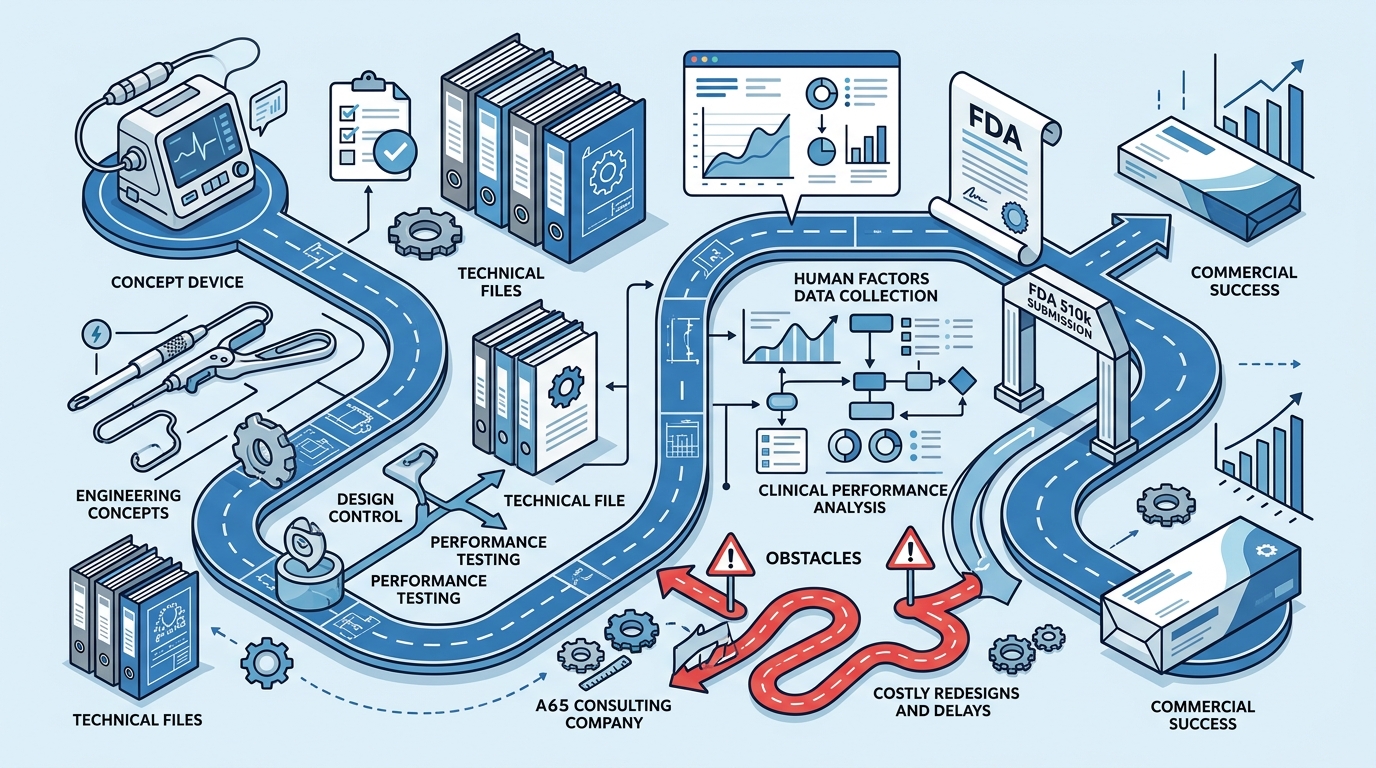
Navigating the regulatory landscape requires precise documentation and strategic planning. Premarket submissions represent a critical milestone for developers seeking market access. Our engineering team has observed that programs lacking early regulatory alignment frequently experience delayed timelines and increased compliance costs. Establishing a clear roadmap before prototyping begins prevents costly redesigns and accelerates your path to commercialization.
Understanding the 510(k) Regulatory Pathway
The 510(k) pathway remains the most common route for commercializing mid to low risk medical devices. Substantial equivalence determines whether your device performs similarly to an existing legally marketed predicate. You must identify a predicate device that shares the same intended use and technological characteristics. Our engineers at A65 Consulting specialize in mapping these technical parameters to ensure your submission meets baseline requirements.
Regulatory strategy begins with a clear classification code. The FDA assigns specific product codes that dictate testing expectations and submission formats. You must verify whether your device falls under exempt or non-exempt categories. Early classification prevents wasted resources on unnecessary testing protocols. Our team reviews your concept against current guidance documents to establish a realistic submission timeline.
Building a Robust Design History File
A Design History File serves as the complete record of device design and development activities. Quality system regulations mandate that every design decision remains traceable and auditable. You must document user needs, system requirements, and interface specifications before moving to detailed engineering. This documentation becomes the foundation for all subsequent testing and manufacturing activities.
Traceability matrices link every requirement to specific design outputs and verification tests. Missing traceability creates submission rejections during initial review. You must maintain version-controlled documents throughout the development lifecycle. Our project management framework ensures that every design change receives proper impact analysis and approval. Our recent publications detail how structured documentation prevents late-stage program delays.
Executing Verification and Validation Protocols
Verification confirms that your device meets specified design requirements. Verification testing proves that engineering specifications match the intended design parameters. Validation demonstrates that the final device performs safely in actual clinical or simulated use environments. Both processes require rigorous statistical planning and documented test protocols.
Design for Manufacturing directly impacts your verification success rate. Our recent projects demonstrate how early manufacturing input reduces prototype iterations. You must align your test methods with production tolerances to avoid validation failures. Our engineers integrate risk management files alongside testing protocols to address potential failure modes. Contact us to schedule a technical review of your current testing strategy.
Transitioning to Contract Manufacturing
Manufacturing transfer requires precise documentation and controlled process validation. ISO 13485 standards establish the baseline expectations for production quality management. You must document every assembly step, calibration requirement, and inspection criterion before handing off to a contract manufacturer. Process validation proves that your production line consistently yields conforming products.
Supplier qualification remains a critical component of successful transfer. You must audit manufacturing partners for regulatory compliance and technical capability. Our engineering team develops detailed work instructions and quality control plans to ensure seamless handoffs. Our services cover the entire spectrum from initial design to final production scaling. We maintain strict version control to prevent manufacturing deviations during scale-up.
Finalizing Quality Management System Compliance
Quality management systems require continuous monitoring and periodic audits. Quality system regulations mandate documented procedures for corrective actions and management reviews. You must establish internal audit schedules to verify ongoing compliance with submission requirements. Regulatory inspectors will examine your complete quality documentation during pre-approval inspections.
Post-market surveillance planning begins before your device reaches commercial distribution. You must establish complaint handling procedures and adverse event reporting workflows. Our team integrates post-market requirements into your initial design phase to prevent compliance gaps. Our about page outlines how we support clients through every development stage. We ensure your quality system remains inspection-ready at all times.
| Transfer Approach | Regulatory Impact | Development Timeline | Recommended Use Case |
|---|---|---|---|
| In-House Prototyping | Minimal initial impact | Extended timeline | Early concept validation |
| Contract Assembly | Requires process validation | Moderate timeline | Mid-stage production scaling |
| Full Manufacturing Transfer | Comprehensive documentation | Accelerated launch | Commercial distribution readiness |
Key Takeaways
- Establish your product classification code before initiating detailed engineering work.
- Maintain complete traceability between user requirements and final design outputs.
- Integrate risk management documentation alongside all verification testing protocols.
- Validate manufacturing processes using statistical sampling before commercial distribution.
- Implement internal audit schedules to verify ongoing regulatory compliance.
- Document every design change through formal impact analysis procedures.
- Schedule technical reviews with experienced engineering partners to accelerate submission readiness.
Frequently Asked Questions
How long does the 510(k) review process typically take?
The FDA generally processes standard submissions within ninety days. Target letters often arrive after initial review cycles conclude. Expedited pathways may reduce review timelines for devices addressing unmet medical needs.
What documentation is required for a Design History File?
A Design History File is a comprehensive collection of records detailing all design and development activities. You must include user requirements, design specifications, verification results, and validation reports. Traceability matrices link every requirement to specific testing outcomes.
Can I modify my device after submitting a 510(k) application?
Post-submission modifications require formal supplemental documentation. You must evaluate whether changes affect substantial equivalence to your predicate device. Our engineering team assesses modification impacts before implementation to prevent regulatory delays.
How do I select an appropriate predicate device?
Predicate device selection determines your entire testing strategy. You must identify a legally marketed device with identical intended use and similar technological characteristics. Our specialists analyze existing market devices to establish the most defensible comparison baseline.
What quality management standards apply to manufacturing transfer?
Quality management standards establish baseline expectations for production compliance. ISO 13485 certification remains the global benchmark for medical device production. You must document all production processes and maintain audit-ready records.
When should I engage a contract manufacturing partner?
Contract manufacturing partners should engage after design freeze and process validation. You must complete all verification testing before transferring production responsibilities. Our team coordinates technical handoffs to ensure seamless production scaling.
What happens if the FDA requests additional information?
Additional information requests require prompt technical responses. You must address every reviewer comment with supporting data or revised documentation. Our engineers draft comprehensive responses to minimize review cycle extensions.
Ready to Accelerate Your Development Timeline?
Navigating regulatory requirements and manufacturing scaling demands experienced engineering leadership. Our engineering team transforms complex device concepts into commercially viable products. We provide comprehensive project management, technical documentation, and production support to ensure your submission meets all regulatory expectations. Book a discovery call today to discuss your specific development requirements and establish a clear path to market.